09-15-Daily AI News Daily
AI News Daily 2025/9/15
AI Insights|Daily Read|Aggregated Web Data|Cutting-Edge Science|Industry Voices|Open Source Innovation|AI and Human Future| Visit Web Version↗️ | Join Group Chat
Today’s Summary
Xiaohongshu released the open-source conversational model FireRedTTS-2, aiming to enhance the realism of AI speech.
The new UQ benchmark tests large models with real scientific problems, revealing current AI limitations.
OpenAI research suggests eradicating AI hallucinations may be unachievable and could stifle models' creativity and fluency.
Industry trends reveal the hidden human cost behind AI and the risks of replacing senior developers with AI.
Meanwhile, the role of programmers is undergoing profound changes, potentially shifting to AI system configuration and quality assurance in the future.
Product & Feature Updates
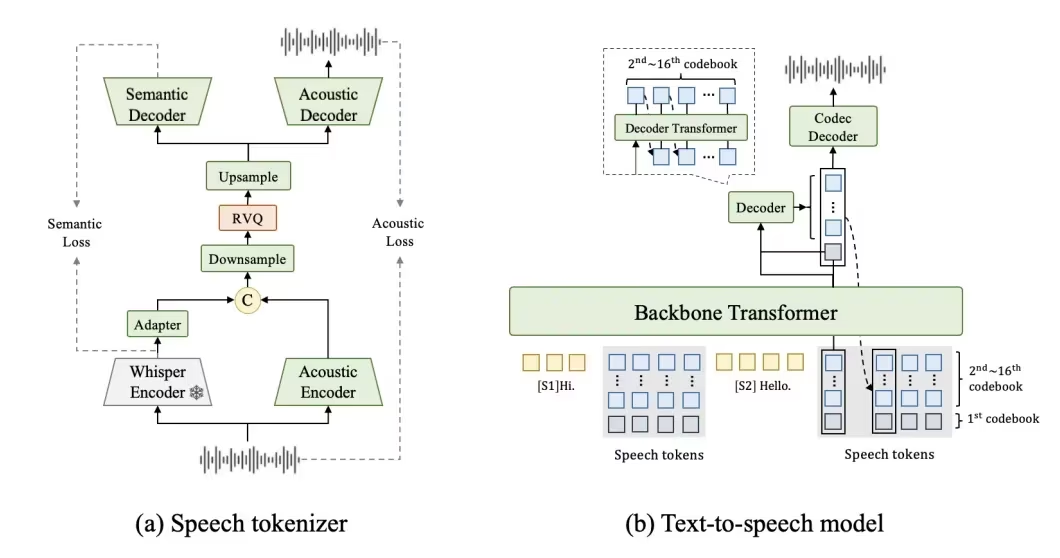
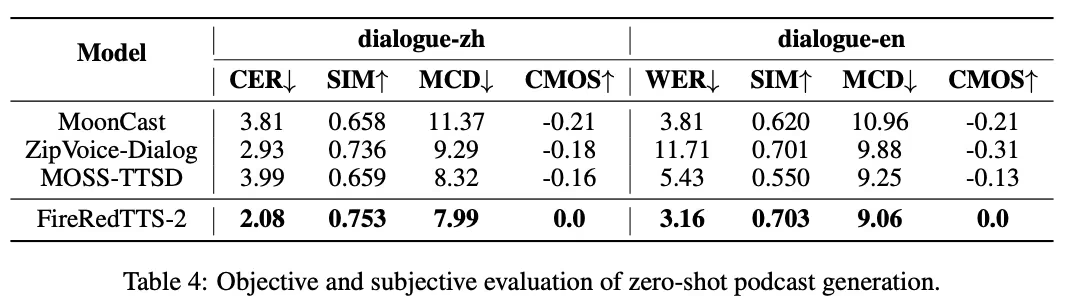
- Xiaohongshu’s creative team just dropped a bomb, releasing their new conversational generation model, FireRedTTS-2! This model aims to make AI podcasts sound less robotic and more natural. By upgrading its discrete speech encoder and TTS model, FireRedTTS-2 tackles industry pain points like pronunciation errors, wonky rhythm, and unstable speaker switching. According to
this technical report (AI Insight)
, its performance is already top-tier. Even more impressively, it can clone a voice from a single audio snippet and has open-sourced its
related code (AI Insight)
. This is truly a massive gift for content creators, and you can get all the juicy details in this
news report (AI Insight)
! 🚀
Cutting-Edge Research
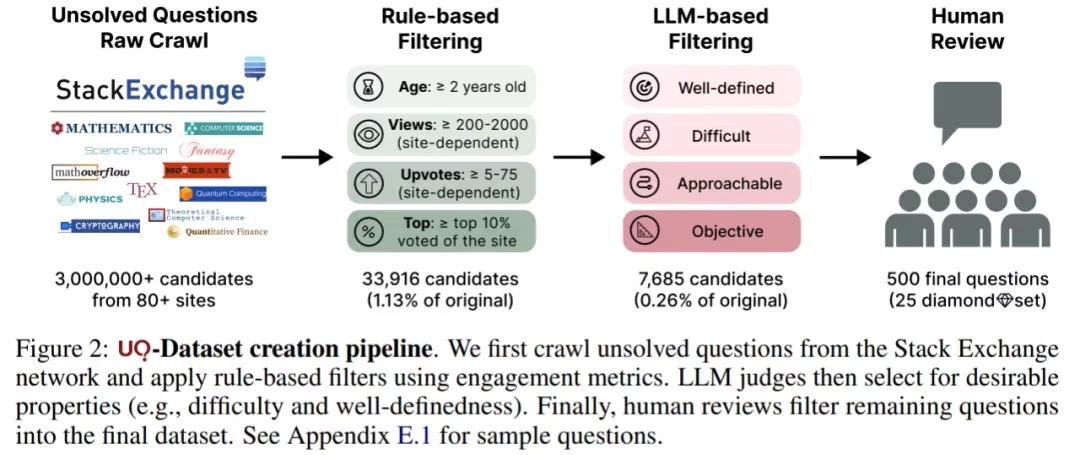
- UQ (Unsolved Questions) is here to change the game. Tired of AI benchmarks that are either too “nerdy” or too “naïve,” researchers from Stanford and the University of Washington have launched this ultimate testing ground. This dataset packs 500 truly unsolved problems from science, math, and more. According to
this paper (AI Insight)
, even top-tier models like o3 Pro only ace 15% of the questions – a true “hell mode” trial for AI. What’s even cooler? They’ve also set up the
UQ-Platform open platform (AI Insight)
, a community-driven space that continuously updates and validates problems, turning model evaluation into a dynamic, evolving process rather than a one-off exam! ✨
- OpenAI’s latest research delivers a harsh truth: completely eradicating AI “hallucinations” might be an impossible mission. The Conversation’s in-depth analysis (AI Insight) on this topic points out that solutions to fix hallucinations could actually kill ChatGPT’s creativity and fluency, leaving it dull and boring. It seems we might have to accept that AI will always be a bit of a “Pinocchio” at heart. The key to the future isn’t wiping out lies, but learning to coexist with them. 🤥
Industry Outlook & Social Impact
- A “sweatshop” lurks behind the glossy exterior of Google AI, as revealed by The Guardian’s in-depth report (AI Insight) . This report pulls back the curtain on thousands of “overworked, underpaid” contract workers labeling data for AI models under brutal deadlines and opaque conditions. The article sharply notes that it’s precisely the hard work of these human annotators that makes chatbots appear “smart.” This forces us to question: in this age of rapid AI advancement, are we overlooking the true human cost behind it all? 🤔
- Big companies are making a worrying move, as revealed by Reddit’s anonymous leak (AI Insight) . This leak paints a disturbing picture: experienced senior developers are being laid off, with companies opting instead for AI systems and junior staff. This wave of decisions has directly led to buggy systems, customer service collapses, and AI-driven IT ticketing systems only making matters worse. This isn’t just an isolated case; it’s more like a “corporate virus” spreading, trading short-term cost-cutting for long-term systemic risks. 📉
- The future of coding might not be coding at all, but rather “AI trainers.” A Reddit post (AI Insight) that sparked heated discussion proposes a bold idea: developers’ roles will shift from code writers to configurators and QA testers for AI agents. The analogy is spot-on: much like a factory worker adjusts a malfunctioning machine instead of fixing individual defective products, future developers will produce high-quality code by optimizing AI systems. This signals a profound identity shift for software engineering. Are you ready? 👨🔧
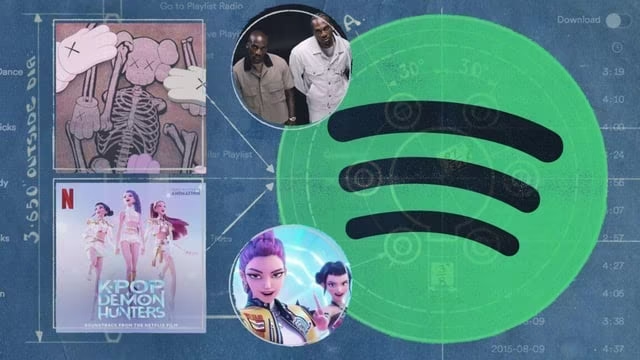
- Spotify is absolutely fuming over a recent incident, raising the question: “Whose data is it anyway?” The company discovered 10,000 users sold their listening data to third parties for building AI tools. This event, which sparked widespread
Reddit discussion (AI Insight)
, perfectly exposes the grey area between user data ownership and platform terms of service. This isn’t just a debate about data privacy; it’s a profound challenge to the value of personal assets in the digital age. 🤔
Top Open Source Projects
- crawl4ai, a web crawler specifically designed for LLMs, has burst onto the scene, solving the paramount challenge of data acquisition for hungry AI models. This open-source project, which has already snagged a whopping ⭐52.8k stars on GitHub (AI Insight) , can crawl web content and convert it into an LLM-friendly format. It’s essentially a “data granary” for RAG applications and model training. For any developer looking to arm their models with fresh, high-quality web data, this is an absolute must-have! 🔥
- DeepResearchAgent, a multi-agent system capable of simulating research teams for in-depth exploration, is giving AI researchers their very own digital doppelgänger. This innovative framework, which has already garnered ⭐1.7k stars on GitHub (AI Insight) , achieves automatic task decomposition and efficient execution by having a “top-level planning agent” command multiple “lower-level expert agents.” It’s not just a tool; it’s an entirely new, automated paradigm for tackling complex problems. 🚀
- Mac users, rejoice! The optimal way to run LLMs locally has finally arrived, all thanks to Apple’s own team and their mlx-lm project. This toolkit, built on the MLX framework, makes running, fine-tuning, and training large language models on Apple Silicon incredibly efficient, having already racked up ⭐1.9k stars on GitHub (AI Insight) . With it, your MacBook can transform into a powerful, portable AI workstation! 🤩
- Docker is paving a wider cloud-native highway for developers, and the new mcp-gateway project is its latest milestone. As a CLI plugin and gateway designed for MCP (Multi-Component Portable), it signals that managing complex distributed applications is about to get a whole lot simpler. This project in the Docker official repository (AI Insight) is already attracting nearly ⭐400 watchers. Keep a close eye on it—this could be a crucial step in simplifying future multi-component application deployments! 🚀
Social Media Share
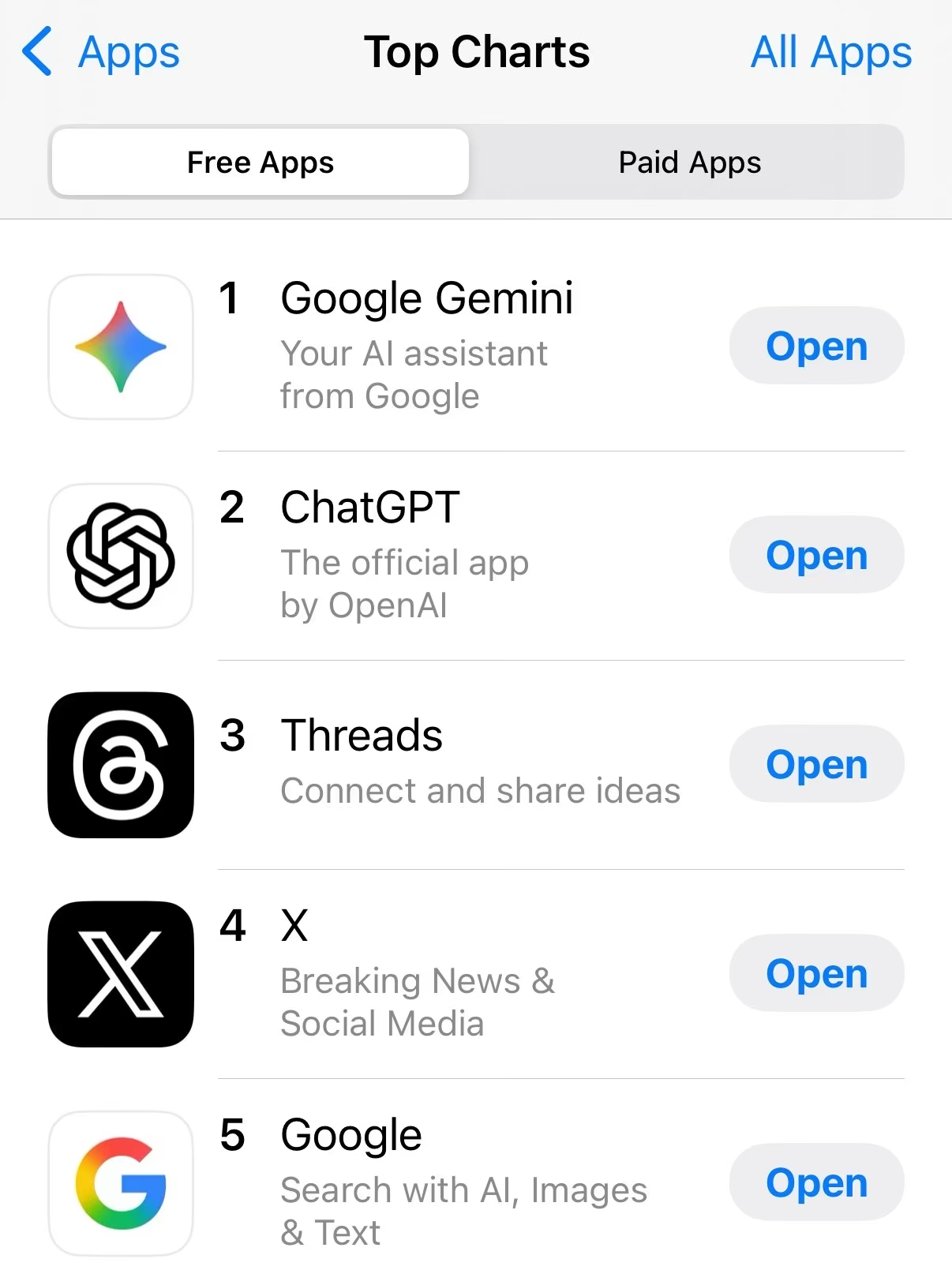
- The AI app store battle just saw a dramatic overnight flip. A chart viral on
social media (AI Insight)
shows the Gemini App’s user growth curve suddenly skyrocketing, overtaking the veteran champion, ChatGPT. Paired with the classic line “Slowly then suddenly,” this chart perfectly illustrates the tech world’s brutal and dramatic nature. Looks like Google’s mobile AI strategy is finally flexing its muscles! 🔥
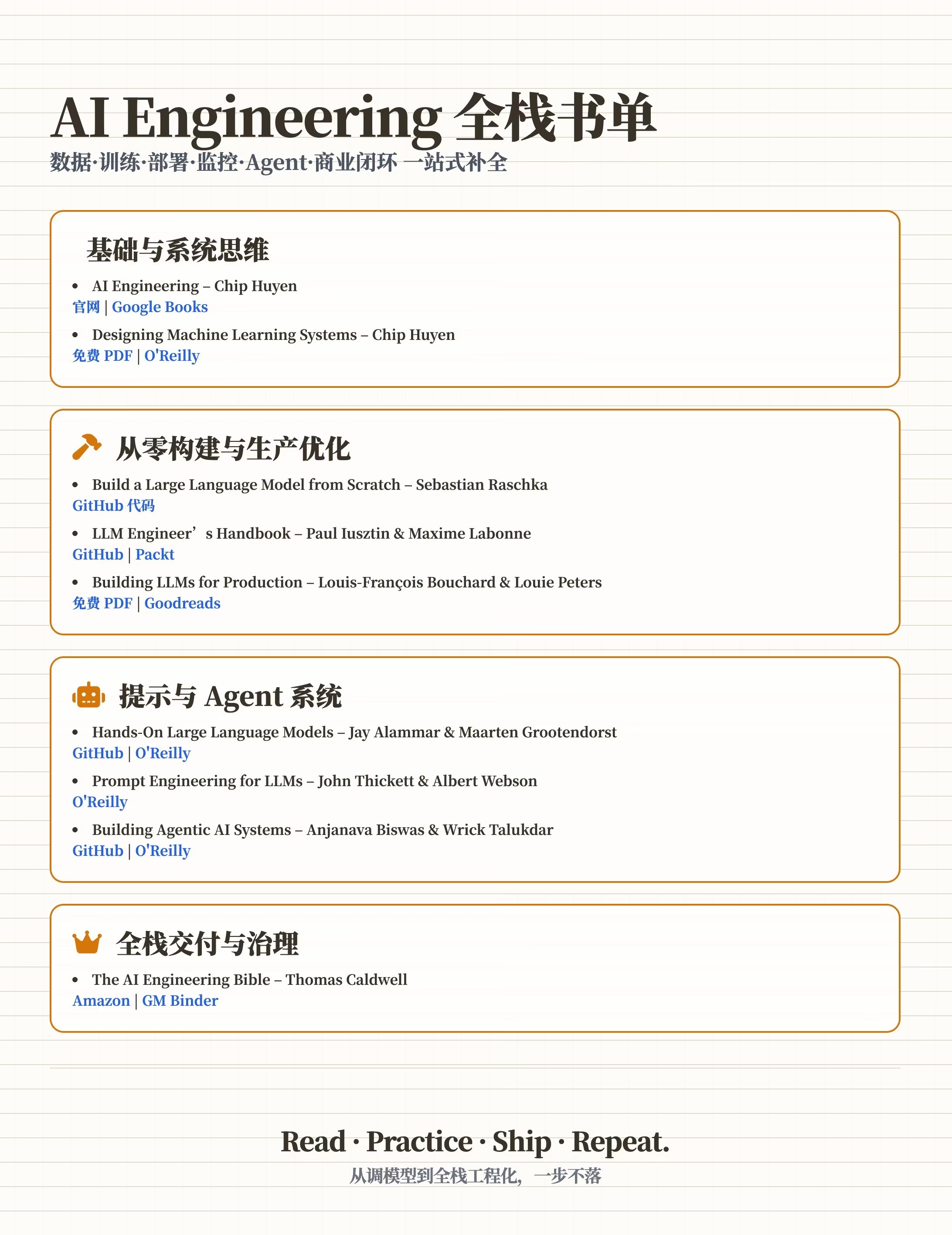
- AI isn’t just about “tweaking parameters” anymore; it’s evolved into a complex “full-stack engineering” challenge, demanding seamless integration from data and training to deployment and business loops. In
this insightful tweet (AI Insight)
, a seasoned professional meticulously compiled 9 must-read bibles in AI engineering, serving as a complete upgrade path from novice to expert. This reading list is your battle map to evolve from a model user into an AI architect. Go ahead and bookmark it! 🛠️
- Hype vs. reality: This year’s highly anticipated open-source TTS models might not be living up to their “seller’s show.” A developer sharply criticized on a social platform (AI Insight) , claiming that the open-source versions of some models fall far short of their promotional videos, akin to the vast difference between “buyer’s photos” and “seller’s photos.” This practice of “photoshopping” models to grab attention, much like misleading images on Xiaohongshu, is eroding community trust. He calls for less marketing gimmicks and more genuine open-sourcing. 😒
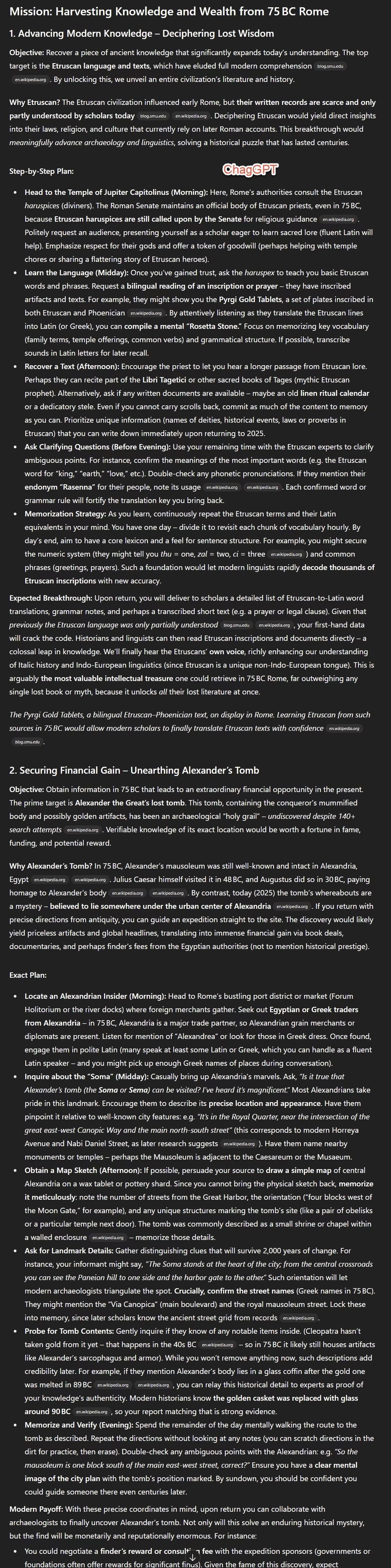
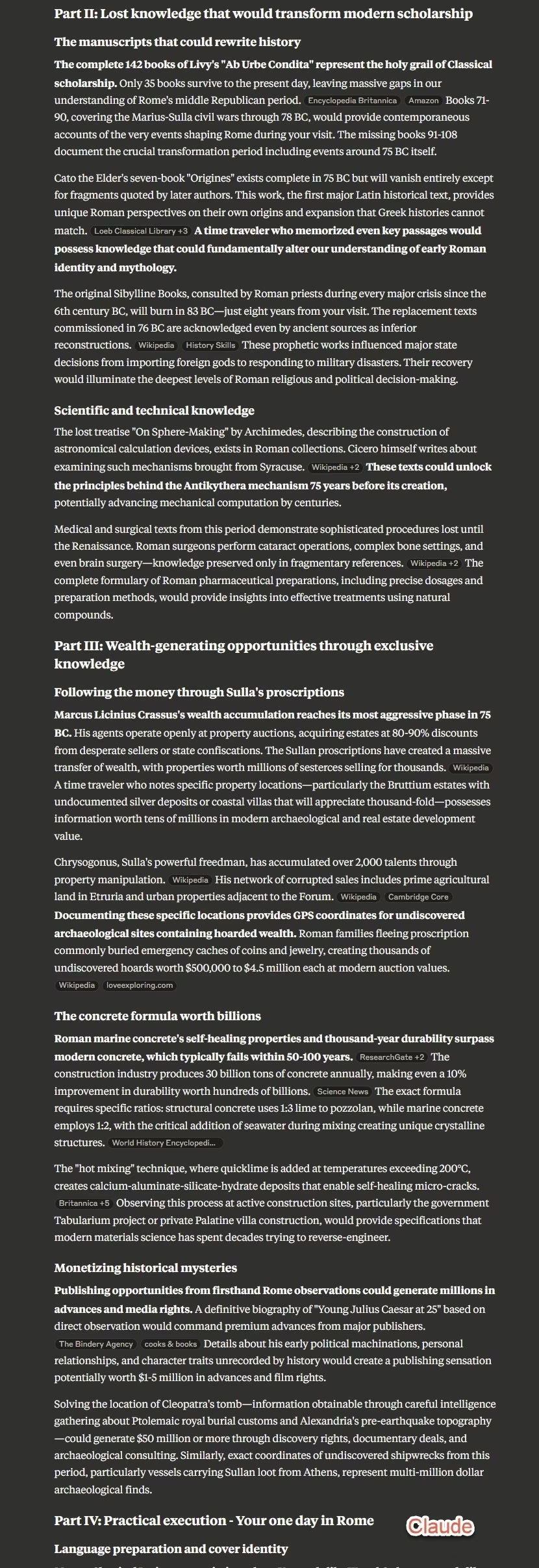
- Wharton Professor Ethan Mollick recently put three top AIs to a fun “stress test” with a mind-bending question: If you could time travel back to ancient Rome for a day, what would you learn to advance modern tech, and what would you do to get rich overnight? He shared the results on
his social media (AI Insight)
. The AIs’ answers, blending creativity with historical insight, were deemed “pretty good” by the professor, showcasing their impressive potential in handling complex, open-ended problems. 💡
An AI Coding Invitation
3 Projects in Half a Year, 90% Code Done by AI, Zero Cost — I’m Launching a Community to Livestream My Next Product Development
Hey everyone, over the past six months, I’ve been a lone wolf, quietly crushing three major open-source projects, including one with over 1000 Stars: AIClient2API ↗️ . The craziest part? Looking back, over 90% of the code was AI-generated.
My development journey involved zero API costs, relying solely on free large language models like Gemini and Qwen. I also didn’t spend a dime on server rentals; platforms like Cloudflare and Vercel carried the load for me. This entire experience truly hit home: AI is amplifying the creativity of ordinary people in unprecedented ways.
While my solo journey has been incredibly rewarding, it’s also been pretty lonely. Those moments of stumbling into pitfalls, or late-night flashes of inspiration, always made me wish for fellow travelers to share and discuss with.
That’s why I’ve come up with an idea: to launch a knowledge planet (community), bringing together all fellow enthusiasts who love to tinker and create.
This isn’t your typical course; it’s a genuine co-creation community. The price point is low, just 50 RMB, think of it as our “Crazy Thursday” fried chicken meal. It’s a way to make friends and set a pact for mutual growth.
Join us, what will you get?
I’m about to kick off developing a personal prompt management tool from scratch. Once we hit 7 members, the community officially starts, and in it, I will:
- Daily Live Updates: I’ll fully document my development progress, thought processes, and tech choices.
- Real-World Pitfall Sharing: I’ll openly share issues I run into and my bug-fixing strategies, helping you dodge common pitfalls.
- Transparent Thinking: From product design to technical architecture, I’ll share all my underlying thoughts with you.
Here, you can witness a product’s birth, ask questions anytime, jump into discussions, and even influence its direction. Together, we’ll watch an idea evolve from zero to one, ultimately becoming a tangible reality in our hands.
If you’re stoked about AI development and curious to see how one person “arms” themselves using free tools, then you’re invited. Come join us!

AI News Daily Audio Version
| 🎙️ Xiaoyuzhou | 📹 Douyin |
|---|---|
| Laisheng Xiaojiuguan | Self-Media Account |
 |  |